
See the top medical billing denials in 2026, what causes them, and how denial management services help providers stop lost revenue before it starts.
Most practices do not lose revenue because they gave the wrong care. They lose it because a claim went out with one wrong detail. It might be a member ID with a typo, a missing authorization, or a code that does not match the note. Weeks later, the payer sends it back as a denial. By then the front desk has moved on, the patient has been seen, and the claim sits in a queue nobody has time to work.
In 2026, this is getting harder to manage, not easier. This guide covers the most common medical billing denials this year, why they happen, where in the process they start, and what a strong prevention system looks like. It also explains where professional denial management services fit in.
What are the top medical billing denials in 2026? The most common healthcare claim denials come from missing or inaccurate claim data, missing or invalid prior authorization, incorrect patient registration or eligibility information, coding errors, services a plan does not cover, coordination of benefits (COB) mistakes, duplicate claims, and missed timely filing deadlines.
How are they prevented? Claim denial prevention works at the front end: verify coverage and authorizations before the visit, keep coding and documentation aligned, scrub claims before submission, and track every denial back to its root cause. Practices that do not have the staff to do this consistently often work with a medical billing denial management partner like Avorcms Services.
Why Medical Billing Denials Matter More in 2026
Denials are not a small leak. They are one of the biggest drains on practice revenue, and the trend is moving the wrong way.
Experian Health's 2025 State of Claims survey found that 41% of providers now see denial rates of 10% or higher, up from 38% in 2024. The same survey reported that 54% of providers say claim errors are increasing, 68% say submitting clean claims is harder than a year ago, and 43% say they are understaffed.
Put those numbers together and the picture is clear. Payer rules are getting more complicated, staff are stretched thin, and small data mistakes are costing real money.
There is some good news. A 2025 revenue cycle report from Kodiak Solutions found that 11% of commercial outpatient claims were initially denied, but only 3% ended up as final denials. In other words, most denied claims can eventually be paid, but only if someone works them, on time, with the right documentation. Every denial that is not worked is revenue your practice earned and never collected.
Hard Denials vs. Soft Denials (And Why It Matters)
Not all denials are the same, and treating them the same way is a common mistake.
Soft denials are temporary. The claim can be corrected and resubmitted or appealed. A missing modifier or a missing attachment is a soft denial.
Hard denials are final. The payer will not pay, and the claim has to be written off. A missed timely filing deadline is the classic example.
Avoidable denials come from your side, such as data errors, authorization gaps, and registration mistakes.
Unavoidable denials come from payer policy, such as plan exclusions and benefit limits. You cannot always stop these, but you can plan for them.
The real money is in the avoidable, soft denials. They are the ones a good process stops before submission, or recovers quickly after.
The Top Medical Billing Denials in 2026
Experian's survey named the leading causes of denials. They are missing or inaccurate claim data (50%), authorizations (35%), incomplete or incorrect patient registration data (32%), code inaccuracy (24%), and services not covered (23%).
Here is how those play out in daily billing, along with the other denials we see most often.
1. Missing or Inaccurate Claim Data
This is the number one cause, and it is the most frustrating because it is so preventable. It covers wrong dates of birth, mismatched names, invalid member IDs, missing rendering provider details, and incomplete claim fields. Payers typically return these under CARC 16 (claim lacks information) or CARC 31 (patient cannot be identified as an insured).
Where it starts: Front desk and intake. One small error at registration travels through the entire claim.
2. Missing or Invalid Prior Authorization
When a plan requires authorization and the claim goes out without it, or with an expired or mismatched one, the payer denies the claim. This usually appears as CARC 197 (precertification or authorization absent).
This one hits behavioral health, ABA therapy, and rehabilitation practices especially hard. Authorizations often cover a set number of visits or units, and one extra session can push a claim past what was approved.
Where it starts: Before the visit, or when no one tracks authorization limits.
3. Patient Registration and Eligibility Errors
The patient's coverage ended last month. The plan changed at the start of the year. The patient has a new card but the practice still has the old one. The claim is denied because the patient was not eligible on the date of service, often under CARC 27 (expenses incurred after coverage terminated).
Registration and eligibility problems are among the most common causes of healthcare claim denials, and the most predictable. Coverage can and should be checked before the patient is seen.
Where it starts: The scheduling and check-in workflow.
4. Coding Errors and Documentation Mismatches
The code on the claim does not match the diagnosis, the modifier is missing, or the documentation does not support the level of service billed. Common examples include:
A diagnosis that does not support the procedure (CARC 11)
A modifier problem (CARC 4)
A service bundled into another service (CARC 97)
Time-based codes that do not match the clinical note, such as 90834 vs. 90837 in therapy
Physical therapy claims affected by timed-unit rules and modifiers
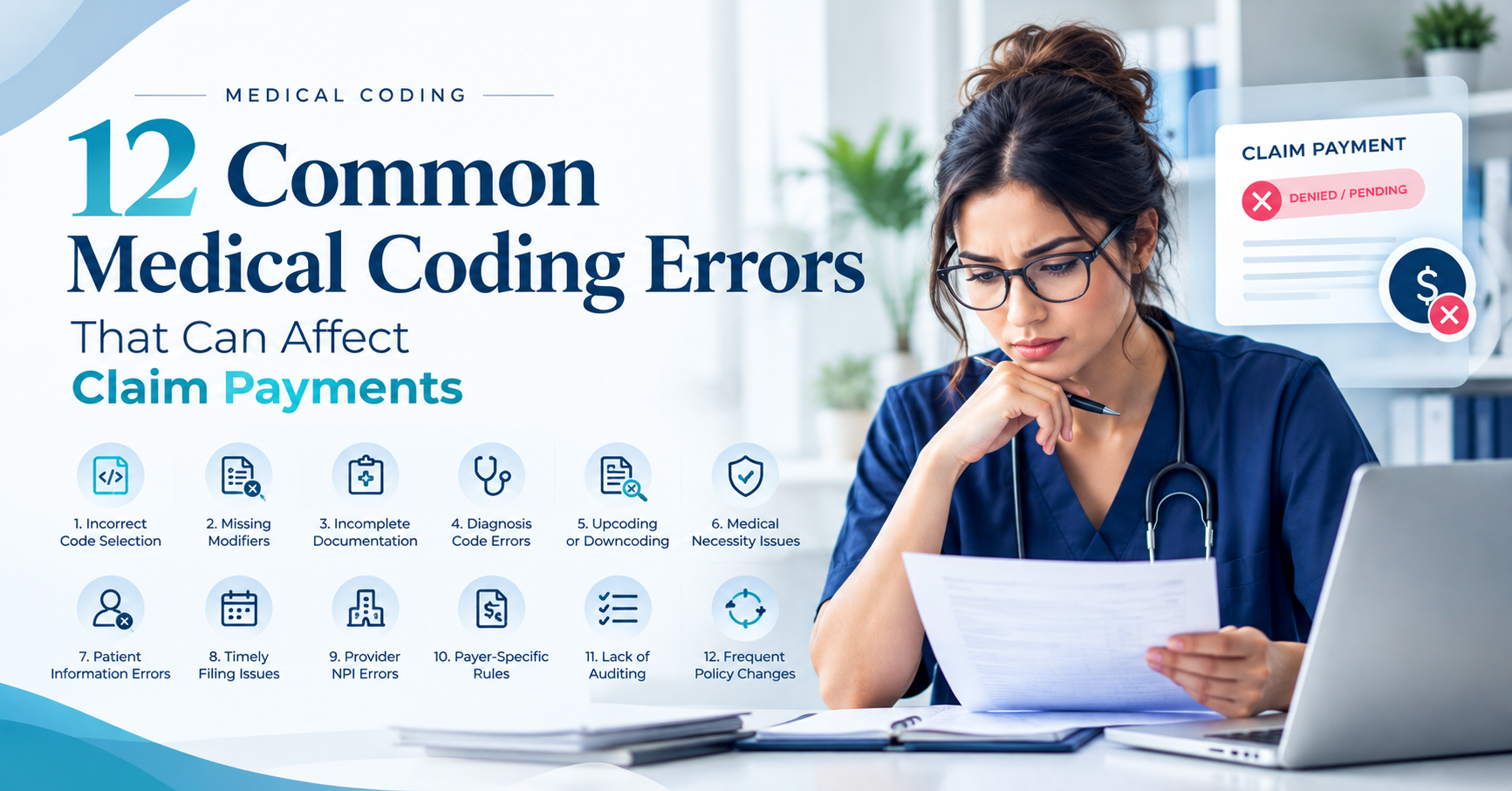
Our guide to 12 common medical coding errors that can affect claim payments covers the most frequent ones.
Where it starts: The gap between the clinical note and the claim.
5. Medical Necessity Denials
The payer decides the service was not medically necessary based on the diagnosis, documentation, or its own policy (CARC 50). These denials are rising in specialties where payers review frequency and duration closely, including behavioral health, therapy, and rehabilitation.
Where it starts: Documentation quality, and payer-specific medical policy that changes often.
6. Services Not Covered or Benefit Limits Reached
The plan excludes the service, or the patient has used up their annual visit limit (CARC 96 and CARC 119). Some of these are unavoidable, but many are not. If the practice knew about the limit before the visit, the patient could have been told about their financial responsibility up front.
Where it starts: Benefit verification that was skipped or incomplete.
7. Coordination of Benefits (COB) Errors
The patient has two plans, and the claim went to the wrong one first (CARC 22). Or the secondary claim went out without the primary payer's explanation of benefits. COB problems are common with children covered by both parents, patients on Medicare plus another plan, and patients with Medicaid. Our guide on coordination of benefits, secondary insurance, and the Birthday Rule explains the payment order in detail.
Where it starts: Insurance verification that confirms active coverage but not payer order.
8. Duplicate Claims
The same claim was submitted twice, often because someone thought the first one was lost (CARC 18). This is a billing-workflow problem and a sign that claim status is not being tracked closely.
Where it starts: Weak claim tracking and unclear ownership of follow-up.
9. Timely Filing Denials
Every payer has a filing deadline, and when it passes, the claim is almost always lost for good (CARC 29). This one is especially painful because it usually means a claim sat untouched or kept getting rejected and was never corrected in time.
Where it starts: No system that watches the clock on aging claims.
10. Out-of-Network and Credentialing Denials
The provider is not enrolled with the payer, or enrollment is still pending, or the provider's credentialing lapsed. The claim is denied no matter how clean it is (CARC 109 is a common one). If you are adding a new clinician or a new payer, our guide on how insurance credentialing works shows why timing matters.
Where it starts: Credentialing and payer enrollment that was not finished before billing began.
Quick Reference: Where Each Denial Starts
Denial type | Common CARC | Where the problem begins |
Missing/inaccurate claim data | 16, 31 | Registration and intake |
No/invalid authorization | 197 | Pre-visit workflow |
Eligibility problems | 27 | Scheduling and check-in |
Coding/documentation mismatch | 4, 11, 97 | Coding and clinical notes |
Medical necessity | 50 | Documentation and payer policy |
Not covered / benefit limit | 96, 119 | Benefit verification |
Coordination of benefits | 22 | Insurance verification |
Duplicate claim | 18 | Claim tracking |
Timely filing | 29 | Follow-up and AR monitoring |
Not in network | 109 | Credentialing and enrollment |
Notice that most of these start long before the claim is submitted. That is the key idea behind claim denial prevention: you cannot fix a front-end problem by working harder at the back end.
What Is Different About Denials in 2026?
Three things stand out this year.
1. Prior authorization rules are changing, but not evenly.
Since January 1, 2026, a federal CMS rule requires many payers to send prior authorization decisions within 72 hours for urgent requests and 7 days for standard requests. They also have to explain their reasons when they deny a request. This is good news for providers. But the rule covers certain payer types, such as Medicare Advantage, Medicaid, and CHIP, and it does not apply to drugs. Many commercial plans still run on their own timelines. Practices now have to track which rules apply to which payer, and the technical requirements keep rolling out through 2027.
2. Payers are tightening their review.
Medical necessity and documentation reviews are more common, and each payer has its own rules. A claim that was paid without question two years ago may get flagged today.
3. Practices are short on people.
With 43% of providers reporting they are understaffed, according to the Experian data above, many practices simply do not have someone whose full-time job is watching denials. Verification gets rushed, follow-up gets delayed, and small problems become write-offs.
The Hidden Cost of Denials
Lost payment is only part of it. Every denial also brings:
Rework time. Someone has to find the reason, gather records, correct the claim, and resubmit or appeal.
Delayed cash flow. A denied claim can add weeks or months to payment, which pushes up your days in A/R.
Aging balances. The longer a claim sits, the lower the odds of collecting it. Aging claims need dedicated AR recovery services to be worked before they hit filing limits.
Staff burnout. Chasing the same denials every month wears down your team.
Missed patterns. If nobody tracks why denials happen, the same mistakes repeat.
If your practice is only fixing denials one claim at a time, you are paying for the same problem again and again.
Why Prevention Beats Appeals
Appeals matter, and a strong appeals process recovers real money. But appeals are the most expensive way to get paid. A claim that is right the first time costs far less than one that has to be reworked.
Many revenue cycle benchmarks treat a denial rate under about 5% as healthy. Practices well above that number are usually dealing with a process problem, not bad luck. Our post on 10 ways medical practices can improve their clean claim rate goes deeper on why first-pass accuracy drives cash flow.
Strong claim denial prevention comes down to a few connected pieces working together:
Accurate registration and eligibility before the visit
Authorization tracking tied to visit and unit limits
Coding that matches documentation
Claims scrubbed against payer-specific rules before submission
Fast, organized follow-up on every denial
Regular analysis of denial trends, so the root cause gets fixed once
Running all of this in-house takes time, training, and constant attention to payer updates. That is the gap professional medical billing denial services are built to fill.
How Avorcms Services Helps Providers Stop Denials
Avorcms Services works as an extension of your front desk and back office. Instead of only reacting to denials, our team works on both sides of the problem: stopping new denials and recovering the ones that already happened.
We start with a clear picture. Our free medical billing audit reviews your denial rates, coding accuracy, and claim history so you can see exactly where revenue is leaking and why.
We work at the root cause, not just the claim. Our team identifies whether a denial came from eligibility, authorization, coding, COB, or payer policy, then fixes the source so it stops repeating. This is the core of our medical claim denial management approach.
We cover the full cycle. Denials rarely come from a single department. That is why our medical billing services, coding support, medical credentialing services, and eligibility and authorization support work together under one revenue cycle management program, with a dedicated account manager who knows your practice.
We chase what others abandon. Older denied and unpaid claims get worked by our A/R specialists, including claims 60, 90, and 120+ days old.
You see everything. You get regular, easy-to-read reports on denials, collections, and trends, so you always know where your practice stands.
There is no long-term lock-in. You work with a dedicated billing team that treats your practice like their own.
One practice manager told us the team recovered over $150,000 in aged claims within 90 days.
Built for Your Specialty
Denial patterns look different depending on the type of practice. Behavioral health practices deal with session limits, carve-out vendors, and time-based coding. ABA and therapy practices manage unit-based authorizations. Family and internal medicine practices face high claim volume and eligibility turnover. Orthopedics, OB-GYN, chiropractic, pediatrics, and ophthalmology each come with their own payer rules.
Our team handles denials across all of these. See the full list of medical billing specialties we support.
Denial Management Services in St. Petersburg, FL
Avorcms Services is based in St. Petersburg, Florida, and supports independent practices, group practices, and healthcare providers across the United States. If you are searching for denial management services in St. Petersburg, FL, our local team works with practices that deal with Florida payer mixes, including commercial plans, Medicare, and Medicaid managed care, while also serving providers in every other state.
Whether you are a solo provider down the street or a multi-location group in another state, you get the same dedicated account manager and the same level of detail.
Signs It May Be Time for Outside Denial Help
Consider medical billing denial management support if:
Your denial rate is above 10%, or you do not know what it is
The same denial reasons keep showing up month after month
Claims are aging past 60 or 90 days with no one working them
Staff are spending more time on rework than on patients
You have missed timely filing deadlines
You are adding providers, payers, or locations and billing is getting harder to manage
Secondary claims and COB issues are slipping through
If more than one of these sounds familiar, a short audit will show you how much revenue is at stake.
Stop Losing Revenue to Denials
Every denial is a claim you already earned. You should not have to chase it down, and your staff should not have to guess why it was rejected.
Avorcms Services helps providers get paid faster, deny less, and focus more on patients. Start with a no-obligation review of where your revenue is going.
👉 Request your free medical billing audit | Call (727) 662-8558 | [email protected]
For a wider look at where billing is heading, read our take on the future of medical billing and AI automation, or start with the basics in our complete guide to medical billing. To see the full list of denial causes, read 15 common reasons medical claims are denied.
Frequently Asked Questions
1. What are the most common medical billing denials?
The most common medical billing denials come from missing or inaccurate claim data, missing or invalid prior authorization, patient registration and eligibility errors, coding mistakes, and services the plan does not cover. Coordination of benefits errors, duplicate claims, and missed timely filing deadlines are also frequent.
2. What is medical billing denial management?
Medical billing denial management is the process of finding why claims are denied, correcting and resubmitting or appealing them, and fixing the underlying cause so the same denial does not happen again. It covers both recovering lost revenue and preventing future denials.
3. What is a good claim denial rate?
Many revenue cycle benchmarks treat a denial rate under about 5% as healthy. Industry surveys show that a large share of providers sit well above that. Experian's 2025 survey found that 41% of providers had rates of 10% or higher.
4. What is the difference between a rejection and a denial?
A rejection happens before the claim is accepted for processing, usually because of a formatting or data error caught by the clearinghouse or payer. A denial happens after the payer processes the claim and decides not to pay it. Rejections can usually be fixed and resent quickly, while denials often need corrections or an appeal.
5. What causes most claim denials?
Most claim denials trace back to front-end problems such as bad registration data, missing authorizations, and eligibility errors. Coding and documentation issues come next, followed by payer policy and coverage limits.
6. How can practices prevent healthcare claim denials?
Claim denial prevention starts before the visit. It means verifying coverage and benefits, tracking authorizations, making sure coding matches documentation, checking claims before submission, and reviewing denial trends regularly. Many practices outsource this to a medical billing company that handles the full process.
7. How long do you have to appeal a denied claim?
It depends on the payer. Appeal windows are set by each plan and are often shorter than people expect, so a denied claim should be reviewed as soon as it comes back. Always check the deadline in the denial notice and your payer contract.
8. Are most denied claims recoverable?
Many are. Kodiak Solutions' 2025 data showed final denial rates far lower than initial denial rates, which means a large share of denied claims are eventually overturned or corrected. Recovery depends on acting quickly and having the right documentation.
9. Does outsourcing denial management actually help?
It can, especially when your team is understaffed or denial rates are climbing. A dedicated partner tracks payer rules, works every denial, watches filing deadlines, and reports on trends so that problems get fixed at the source.
10. Does Avorcms Services offer denial management services in St. Petersburg, FL?
Yes. Avorcms Services is based in St. Petersburg, Florida, and provides medical billing denial services to practices across the United States. Contact us at (727) 662-8558 or [email protected]. We respond within 24 hours.
Disclaimer: This blog is for informational purposes only and is not legal, compliance, or financial advice. Payer rules and deadlines vary, so confirm details with the payer.