Learn how insurance credentialing works in 8 steps, from CAQH and NPI setup to payer enrollment, timelines, required documents, and recredentialing.
Bringing a new provider onto your team should be a milestone, not a billing problem. But there is a catch that catches many practices off guard: a provider cannot bill insurance as an in network provider until they are credentialed, and that process often takes three to four months. If you have a start date approaching, claims building up under a provider who is not yet enrolled, or an application that seems stuck with a payer, you are not the only one. Credentialing delays are one of the most common reasons new providers see denied claims and lost revenue.
The reassuring part is that credentialing follows a predictable path. Once you know the eight steps, from gathering your documents and confirming your NPI to CAQH setup, payer applications, verification, and contracting, you can plan ahead, submit complete applications, and sidestep the small errors that cause most of the delays. You hand it to a credentialing partner who tracks every payer for you.
At Avorcms Services, our medical credentialing services cover provider enrollment, CAQH setup and maintenance, and re-credentialing for healthcare providers across the United States, so your team can stay focused on patients while the paperwork gets handled correctly.
Quick Answer
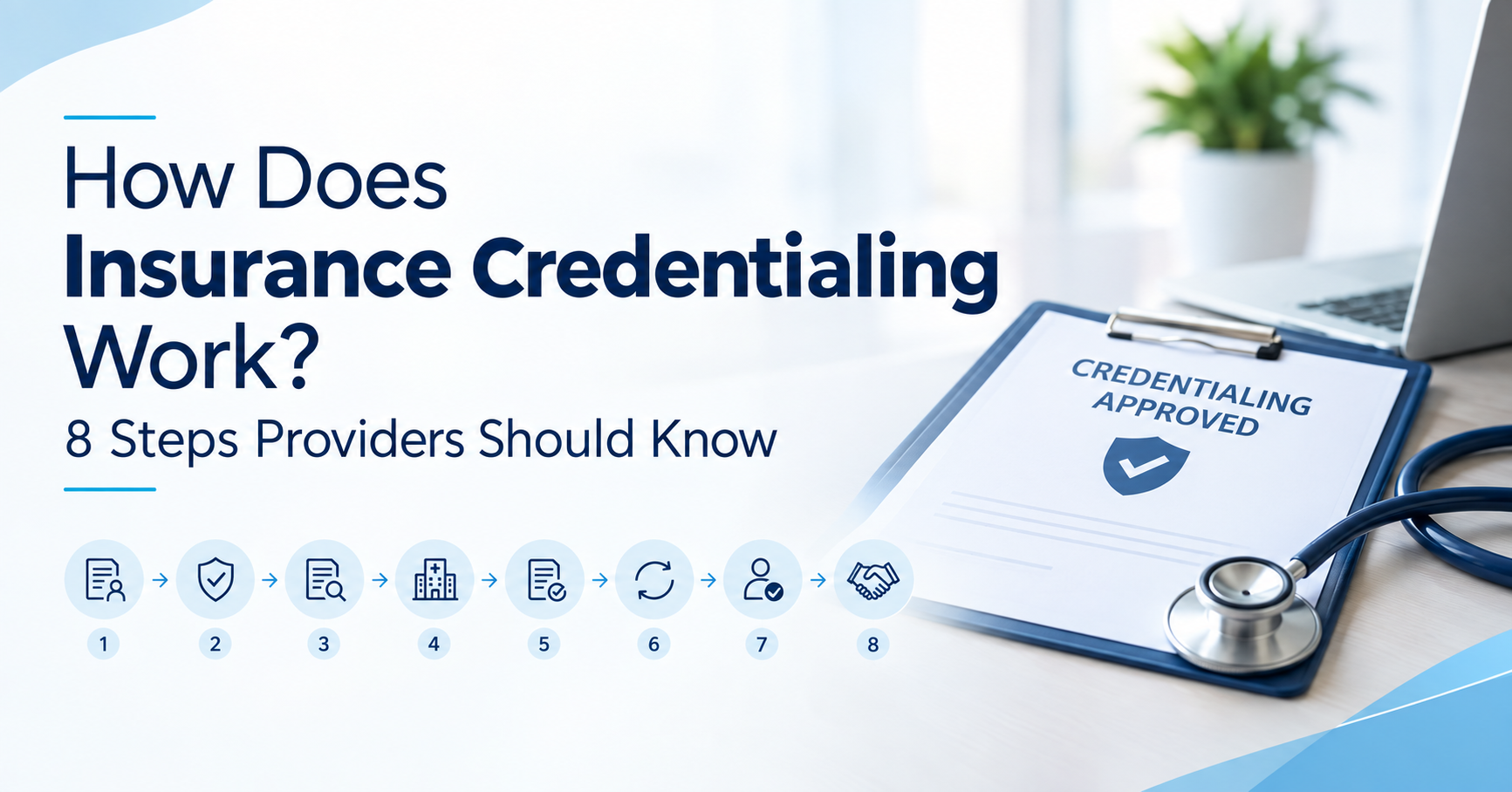
Insurance credentialing is the process insurance companies use to verify a healthcare provider's training, licenses, and history before adding that provider to their network. It usually follows eight steps: gather your documents, confirm your NPI, set up your CAQH profile, choose your payers, submit applications, wait for verification and committee review, sign contracts, and keep your credentials current. Most payers take about 40 to 120 days, and some take longer. The takeaway: start early, submit complete applications, and track every payer until you have an effective date in writing. If you would rather not manage the process yourself, Avorcms Services can handle credentialing and enrollment for you.
Step | What happens | Typical timeframe |
1. Gather documents | Collect licenses, certifications, insurance, and work history | 1 to 2 weeks |
2. NPI | Apply for or update your National Provider Identifier | Days to a few weeks |
3. CAQH | Build and attest your CAQH ProView profile | 1 to 2 weeks |
4. Choose payers | Which plans your patients use and which panels are open | 1 to 2 weeks |
5. Submit applications | Send Medicare, Medicaid, and commercial applications | 1 to 3 weeks |
6. Verification and review | Payer verifies credentials and a committee approves | 60 to 90 days or more |
7. Contracting | Review fee schedule, sign, receive effective date | 2 to 4 weeks |
8. Maintenance | Reattest CAQH, update changes, re-credentialing | Ongoing, re-credentialing about every 3 years |
What Is Insurance Credentialing?
Insurance credentialing is how a payer confirms that a provider is qualified, licensed, and in good standing before allowing that provider to bill as an in network provider. The payer checks your education, training, licenses, board certification, malpractice history, and work history.
People often use three terms interchangeably, but they are different stages:
Credentialing. The payer verifies your qualifications.
Provider enrollment. You are set up in the payer's system so you can submit claims.
Contracting. You and the payer agree on reimbursement rates and terms.
You need all three before you can bill a payer as in network. Missing any one of them is a common reason new providers see claims denied.
Why Does Healthcare Credentialing Matter for Your Revenue?
Credentialing matters because an uncredentialed provider cannot be paid as in network. Claims submitted before your effective date, or under a provider who is not enrolled, are usually denied or paid at out of network rates.
Delays also cost time. A new provider who sees patients for two or three months without active enrollment can build a large backlog of claims that may never be paid. That is why credentialing for healthcare providers should start well before a start date, not after.
Step 1: What Documents Do You Need for Medical Credentialing?
The first step is collecting every document insurance will ask for. Having them organized before you start saves weeks of back and forth later.
Mostly
State medical or professional license. Current and active in each state where you practice.
DEA registration. If you prescribe controlled substances.
Board certification. Or proof of board eligibility.
Education and training records. Degree, residency, fellowship, and graduation dates.
Malpractice insurance. A current certificate of insurance and your claims history.
Curriculum vitae. With a complete work history and explanations for any gaps.
Hospital privileges. Or an admitting arrangement, if the payer requires it.
Practice information. Tax ID, W 9, practice address, and group NPI.
Government issued ID. And other identifying details the payer requests.
Step 2: How Do You Set Up and Maintain a CAQH Profile?
A lapsed CAQH attestation is a quiet but common cause of credentialing delays and re-credentialing problems. Setting calendar reminders, or having a credentialing partner track it, prevents this. If you do not manage, give this work to a credentialing company.
Step 3: How Do You Choose Which Insurance Payers to Join?
Choose payers based on the patients you serve and expect to serve, not on a long list of every plan in your area. Joining the right networks matters more than joining the most.
Consider:
Your patient mix. Which plans do your current and expected patients carry?
Government programs. Whether you will accept Medicare, Medicaid, or both.
Panel availability. Some commercial networks close to new providers in certain specialties or areas.
Reimbursement. Rates vary widely between payers.
Administrative burden. Some plans require more authorizations and paperwork than others.
Step 4: What Type of Provider Enrollment Applications?
Each payer has its own application process, and submitting complete, consistent applications is the single biggest factor in how fast you get approved.
The main paths are:
Medicare
Medicaid.
Commercial payers (PPO / HMO)
Keep a record of every submission, including the date, the confirmation number, and the contact person. You will need it for follow up.
Step 5: What Happens During Verification and Committee Review?
After you submit, the payer verifies your information directly with the original sources and then sends your file to a credentialing committee for approval. This is usually the longest part of the process.
Primary source verification means the payer confirms your credentials with the organization that issued them. That typically includes:
Your license with the state licensing board.
Your education and training with your school and training programs.
Your board certification with the certifying board.
Your malpractice history with your carrier and the National Practitioner Data Bank.
Sanctions and exclusions against federal and state exclusion lists.
Follow up with each payer every two to three weeks. Applications often stall because a payer needs one missing document and no one responds to the request.
Step 6: How Do Contracting and Your Effective Date Work?
Once you are approved, the payer sends a contract with your reimbursement rates and terms. After signing2, you can bill as an in network provider.
Before signing:
Review the fee schedule. Confirm rates for the codes you bill most.
Check the terms. Timely filing limits, termination clauses, and authorization rules.
Get the effective date in writing. Do not assume you are active until you have confirmation.
Confirm your provider ID. Some payers assign their own number for claims.
Once active, make sure your billing team loads the correct provider details and rates into your system. Our medical billing services handle this setup so the first claims go out clean.
Step 7: How Do You Keep Your Credentials Current?
Credentialing is not a one time task. Payers re-credential providers on a regular cycle, usually about every three years, and they expect updates whenever your information changes.
Stay current by:
Reattesting CAQH every 120 days.
Renewing licenses, DEA, and malpractice coverage before they expire, and uploading the new documents.
Reporting changes in address, tax ID, group affiliation, or practice location promptly.
Responding quickly to re-credentialing requests. Missing a deadline can remove you from a network.
Revalidating Medicare enrollment when CMS requests it.
A missed re-credentialing deadline can mean denied claims until you are reinstated. Tracking these dates is one of the most valuable parts of ongoing medical credentialing services.
How Long Does Insurance Credentialing Take?
Insurance credentialing commonly takes about 90 to 120 days per payer, though some payers take longer, especially when applications are incomplete or the payer has a backlog.
The process moves faster when your applications are complete and consistent, your documents are current, your CAQH profile is attested with payer access granted, and someone follows up every two to three weeks. It slows down when details do not match across forms, a license or insurance certificate expires mid process, or a payer has a closed panel or a long queue.
Start at least three to four months before a provider's first day of seeing patients whenever possible.
What Credentialing Mistakes Cause the Most Delays?
Most credentialing delays come from small, avoidable errors:
Inconsistent information. Name, address, or taxonomy differs across NPI, CAQH, and applications.
Expired documents. A license or malpractice certificate lapses mid process.
Unexplained work history gaps.
No follow up. Assuming the payer is working on the file when it is waiting on you.
Billing too early. Seeing and billing patients before the effective date.
Forgetting group linkage. Individual providers not properly linked to the group's billing information.
Credentialing errors often show up later as denials. A credentaling can pinpoint enrollment related denials and other revenue leaks in your recent claims. If those denials are already stacking up, our denial management team can find the root cause and correct it, and our guide to the common reasons medical claims are denied explains what to look for.
Why Should Credentialing Outsource It?
In house credentialing works when you have trained staff with time to manage applications and follow up. Outsourcing to insurance credentialing services makes sense when you are adding several providers, joining many payers, or your team is already stretched.
Factor | In house | Outsourced |
Cost | Staff time and training | Service fee |
Experience | Depends on your staff | Specialists who work with many payers |
Follow up | Often slips when staff are busy | Tracked and scheduled |
Maintenance | Easy to miss CAQH and re-credentialing dates | Dates tracked for you |
Payer Complexity | Staff must manage each payer’s different requirements and processes internally. | Credentialing specialists handle payer-specific requirements and processes. |
How Can Avorcms Services Help With Provider Credentialing?
Avorcms Services handles provider credentialing, payer enrollment, CAQH setup and maintenance, and re-credentialing as an outsourcing partner for healthcare providers. We manage the paperwork and follow up so your team can focus on patients.
Credentialing is also connected to the rest of your revenue cycle. Once you are enrolled, we can support billing, denials, and AR through our revenue cycle management services, with a dedicated account manager who knows your practice. Aging balances are handled by our AR recovery specialists, who work claims that many billing companies give up on. We provide credentialing and billing across the specialties we serve, including behavioral health, therapy and rehabilitation, family and internal medicine, OB GYN, chiropractic, pediatrics, ophthalmology, and orthopedics. You can also see how our team works and what makes us different.
Get In Network Without the Paperwork Headache
Every week a provider waits on credentialing is a week of visits that may not be paid. A clear plan, complete applications, and steady follow up make the difference. Let our team take the enrollment work off your desk.
👉 Start your provider credentialing | [email protected] | Reach the Avorcms Services team
Serving independent practices, group practices, and healthcare providers across the United States.
Frequently Asked Questions
1. What is insurance credentialing for healthcare providers? Insurance credentialing is the process payers use to verify a provider's licenses, education, training, and history before adding that provider to their network. It must be completed before a provider can bill as in network.
2. How long does insurance credentialing take? Most commercial payers take about 90 to 120 days, and some take longer. Complete applications and regular follow up help keep the process moving.
3. What is the difference between credentialing and provider enrollment? Credentialing verifies your qualifications. Provider enrollment sets you up in the payer's system so you can submit claims and get paid.
4. What is CAQH and why do I need it? CAQH ProView is a central database where providers store credentialing information that many commercial payers use. Providers must keep it complete and re-attest every 120 days.
5. Can I see patients before credentialing is complete? You can see patients, but claims billed to a payer before your effective date are often denied or paid out of network. Always confirm your effective date before billing as in network.
6. How often do providers need to be re-credentialed? Most payers re-credential providers about every three years. You also need to update payers whenever your license, address, or practice information changes.
7. What documents are required for medical credentialing? Payers usually ask for your license, DEA registration, CDS registrations, board certification, education and training records, malpractice insurance, CV, IRS, W9 with work history, and practice details such as tax ID and NPI.
8. What happens if a payer panel is closed? The payer is not accepting new providers in your area or specialty at that time. We can ask about exceptions, reapply later, or focus on payers with open panels or switch other options.
9. Does Avorcms Services handle CAQH setup and maintenance? Yes. Avorcms Services handles CAQH setup and maintenance, along with provider credentialing, payer enrollment, and re-credentialing.
10. How do I get help with insurance credentialing from Avorcms Services? Contact our credentialing team through the website, call (727) 662 8558, or email [email protected]. The team responds within 24 hours.
Disclaimer: This blog is for informational and educational purposes only and does not constitute legal, compliance, or financial advice. Payer requirements and timelines vary, so confirm details with each payer.