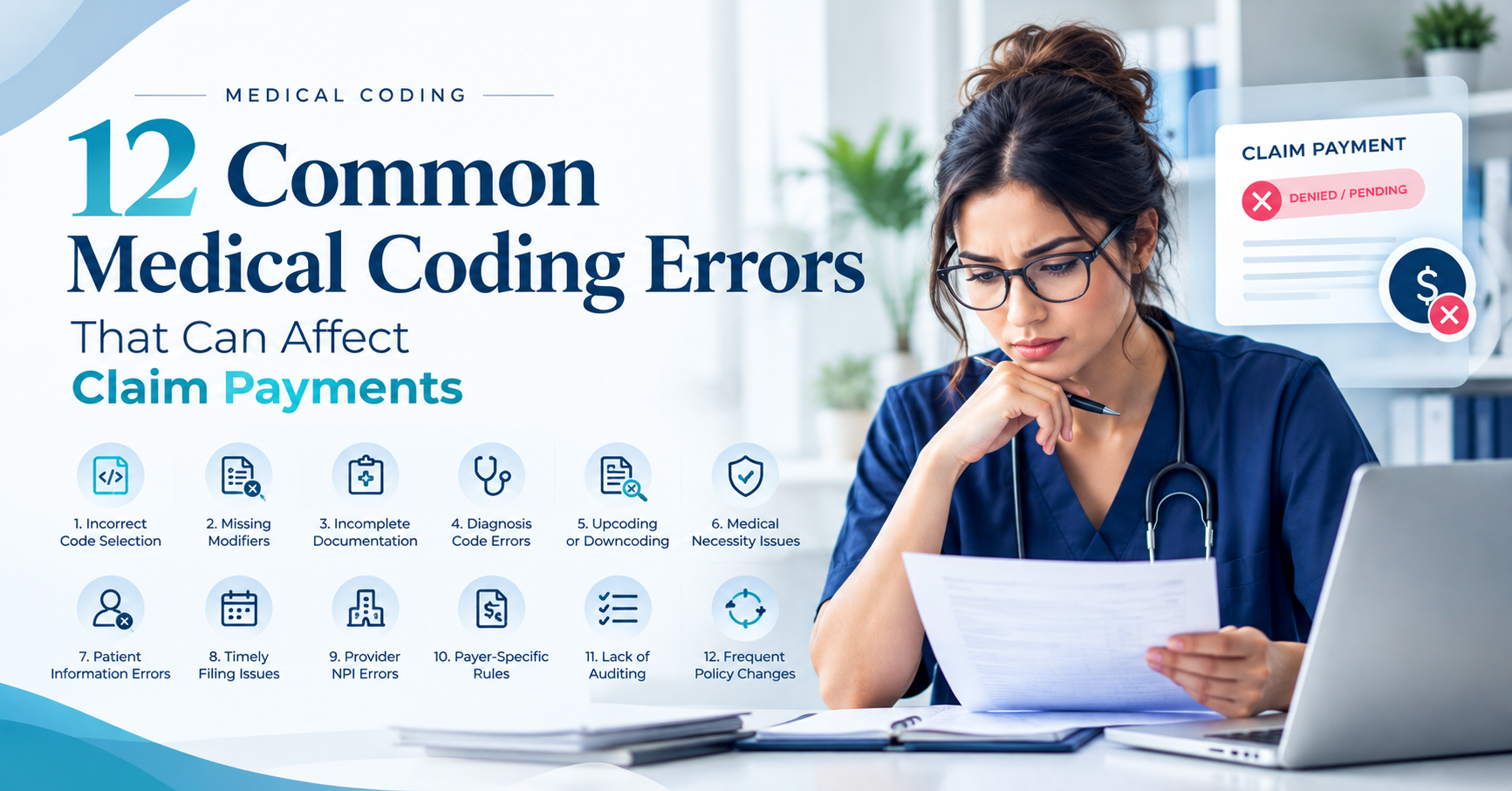
Discover 12 common medical coding errors that delay or reduce claim payments, how to fix them, and when medical coding audit services can protect your revenue.
The most common medical coding errors are upcoding, undercoding, unbundling, missing or wrong modifiers, outdated codes, diagnosis codes that do not support the procedure, and coding without complete documentation. These mistakes lead to denied, delayed, or reduced claim payments and can create compliance risk. Certified coders, clear documentation, claim scrubbing, and regular medical coding audits prevent most of them.
Key Takeaways
Small medical coding mistakes can turn a payable claim into a denial.
Undercoding quietly costs practices revenue even when claims get paid.
Upcoding and unbundling can trigger audits and repayment demands.
Regular coding audits catch error patterns before they become costly.
Medical coding turns every patient visit into the codes payers use to decide what to pay. When those codes are wrong, even by one digit or one modifier, your practice pays the price in denials, rework, and lost revenue. Here are the 12 coding errors in medical billing we see most often, and how to fix each one.
What Are Medical Coding Errors and How Do They Affect Claim Payments?
Medical coding errors are mistakes in the CPT, ICD 10, or HCPCS codes, or the modifiers, used to describe a patient visit on a claim. Because payers pay based on these codes, a coding error can cause a claim to be denied, paid at a lower rate, delayed for review, or flagged for audit.
In medical billing and coding, errors usually hurt your practice in one of four ways:
Denied claim: The payer refuses to pay until the code is corrected or appealed.
Underpayment: The claim is paid, but for less than the service was worth.
Payment delay: The payer holds the claim and requests records.
Compliance risk: Patterns of overcoding can lead to audits and repayment demands.
To see where coding fits in the full claim journey, read our guide on how medical billing works from start to finish.
What Are the 12 Most Common Medical Coding Errors?
1. What Is Upcoding and Why Is It Risky?
Upcoding happens when a claim uses a code for a more complex or expensive service than the documentation supports. Even when it is accidental, repeated upcoding can trigger payer audits, repayment demands, and compliance problems.
How to fix it: Code only what the notes clearly support, and review high level visits before submission.
2. How Does Undercoding Cost Your Practice Money?
Undercoding is the opposite: billing a lower level service than was actually provided, often out of caution. The claim gets paid, so the loss goes unnoticed, but it adds up to significant lost revenue over a year.
How to fix it: Train providers to document the full complexity of each visit, and audit a sample of low level visits regularly.
3. What Is Unbundling in Medical Coding?
Unbundling means billing separately for services that should be reported under one combined code. Payers use NCCI edits to catch this, and the extra lines are usually denied.
How to fix it: Run every claim through NCCI edit checks and only bill services separately when documentation and the correct modifier support it.
4. Why Do Missing or Incorrect Modifiers Lead to Denials?
Modifiers such as 25, 59, and the X modifiers explain special circumstances to the payer. When they are missing, misused, or added out of habit, claims are denied or bundled.
How to fix it: Build modifier rules into your billing system and review high volume modifier use each quarter.
5. Why Are Outdated or Deleted Codes Still a Problem?
CPT, ICD 10, and HCPCS code sets are updated every year. Practices that rely on old superbills or saved code lists end up submitting codes that no longer exist.
How to fix it: Update code sets, templates, and superbills every year before the new codes take effect.
6. What Happens When the Diagnosis Does Not Support the Procedure?
Payers check that each diagnosis code justifies the service billed. If the link is missing, the claim is denied for lack of medical necessity.
How to fix it: Link the most accurate diagnosis to each procedure and check payer coverage policies for tests and imaging.
7. Why Does a Lack of ICD 10 Specificity Cause Problems?
Using an unspecified code when a more specific one is available, such as missing laterality or the type of condition, can lead to denials or requests for records.
How to fix it: Code to the highest level of specificity the documentation allows, and query providers when details are missing.
8. Can You Code From Incomplete Documentation?
No. Coding before notes are finished, signed, or complete is one of the most common medical coding mistakes. If it is not documented, it cannot be coded or defended in an audit.
How to fix it: Set a clear rule that claims are coded only from final, signed documentation.
9. How Do Coders Choose the Wrong E/M Level?
Evaluation and management codes are chosen by medical decision making or total time. Mixing up these rules, or defaulting to the same level for every visit, leads to both overcoding and undercoding.
How to fix it: Train providers and coders on current E/M guidelines and audit E/M distribution by provider.
10. Why Do Incorrect Units Affect Payment?
Time based and drug codes depend on the correct number of units. Billing too many units causes denials; billing too few leaves money behind. This is especially common in therapy and behavioral health billing.
How to fix it: Match units to documented time or dosage and follow payer unit rules for each code.
11. How Do Typos and Transposed Numbers Cause Coding Errors in Medical Billing?
A single swapped digit can turn a valid code into the wrong service or an invalid one. These simple errors are easy to make during manual charge entry.
How to fix it: Use code validation in your practice management system and a claim scrubber before submission.
12. Why Does the Place of Service Code Matter?
The place of service code tells the payer where care was delivered, such as an office, hospital, or telehealth. A wrong code can change the payment rate or cause a denial.
How to fix it: Set default place of service codes by location and visit type, and double check telehealth claims.
Medical Coding Errors at a Glance
Upcoding: Can lead to denial, audit, or repayment. Code only what is documented.
Undercoding: Causes lost revenue. Document the full complexity of each visit.
Unbundling: Line items get denied. Run NCCI edit checks.
Modifier errors: Cause denial or bundling. Build modifier rules into your software.
Outdated codes: Lead to rejection or denial. Update code sets every year.
Diagnosis not supporting the procedure: Triggers a medical necessity denial. Link the right diagnosis.
Lack of ICD 10 specificity: Leads to denial or a records request. Code to the highest specificity.
Incomplete documentation: Causes denial or a failed audit. Code only from signed notes.
Wrong E/M level: Causes overpayment or underpayment. Use E/M training and audits.
Incorrect units: Lead to denial or underpayment. Match units to time or dose.
Typos and transposed digits: Cause rejection or wrong payment. Use code validation and scrubbing.
Wrong place of service: Leads to a lower rate or denial. Set location based defaults.
How Can Healthcare Providers Prevent Medical Coding Mistakes?
The best defense is a process where documentation, coding, and billing check each other before a claim goes out:
Work with certified coders who stay current on CPT, ICD 10, HCPCS, and payer rules.
Improve provider documentation with simple templates and regular feedback from coders.
Scrub every claim for code validity, modifier conflicts, and NCCI edits before submission.
Track denials by reason so repeat coding errors are caught and fixed at the source. Our denial management services do this every month.
Audit on a schedule instead of waiting for a payer audit to find the problem.
When Should You Use Medical Coding Audit Services?
Consider medical coding audit services when your denial rate is rising, your E/M levels look very different from peers, you have added new providers or services, or you have not had an audit in over a year. An outside review finds both overcoding risk and undercoded revenue. Start with a free medical billing audit to see where your coding stands.
Should You Outsource to a Medical Coding Company?
Many practices choose outsourced medical coding services when in house staff are stretched or coding turnover is high. The right medical coding companies offer certified coders, specialty experience, HIPAA compliant workflows, and regular reporting, so coding accuracy does not depend on one person.
Stop Losing Revenue to Coding Errors
Avorcms Services provides medical billing for healthcare providers with certified coders who follow ICD 10, CPT, and HCPCS standards on every claim. Our end to end medical billing services combine accurate coding, claim scrubbing, and denial follow up, all backed by full revenue cycle management and a dedicated account manager.
Every workflow is 100% HIPAA compliant, and there is no long term lock in.
Get a free, no obligation coding and billing audit and see where your claims are losing money.
📞 Call +1 (727) 662 8558 or email [email protected], or request your free billing audit today.
Frequently Asked Questions
1. What are the most common medical coding errors?
The most common medical coding errors are upcoding, undercoding, unbundling, modifier mistakes, outdated codes, and diagnosis codes that do not support the procedure billed.
2. How do coding errors in medical billing affect payments?
They can cause denied claims, lower payments, delays while payers request records, and in some cases audits and repayment demands.
3. What is the difference between upcoding and undercoding?
Upcoding bills a higher level service than documented, which creates compliance risk. Undercoding bills is a lower level than provided, which quietly reduces revenue.
4. How often should a practice do a medical coding audit?
Most practices benefit from an audit at least once a year, and quarterly reviews are helpful for high volume codes or new providers.
5. What do medical coding audit services review?
They review a sample of claims against documentation to check code accuracy, modifier use, E/M levels, and compliance, then report errors and fixes.
6. What is the difference between medical billing and medical coding?
Medical coding translates the visit into standard codes. Medical billing uses those codes to create, submit, and follow up on claims until they are paid.
7. Can a claim scrubber catch coding errors?
A scrubber catches many technical errors, such as invalid codes and modifier conflicts, but it cannot confirm that codes match the documentation. That still needs a trained coder.
8. Is it worth outsourcing medical coding services?
For many practices, yes. Outsourcing gives you certified coders and consistent quality without the cost of hiring and training in house staff.
9. Does Avorcms Services work with my specialty?
We support behavioral health, therapy and rehabilitation, family and internal medicine, and specialty groups. See all the specialties we support.
10. How do I get started with Avorcms Services?
Start with a free billing audit. We review your coding accuracy, claims, and denial patterns, then show you where revenue is being lost.
Medical Disclaimer: This content is for general informational purposes only and is not medical, legal, or professional advice. Always consult a qualified healthcare or billing professional about your specific situation.