Complete 2026 guide to mental health CPT codes: evaluation, psychotherapy, crisis, testing, add-ons, time rules, telehealth modifiers, and billing pitfalls.
A therapist can run a flawless session and still not get paid for it. The note says 50 minutes, but the claim says 90837. The patient is on telehealth, but the modifier is missing. Two sessions fall on the same day, and the player reads one as a duplicate. Nobody did anything wrong clinically. The claim simply did not match the rules.
That is why mental health CPT codes matter so much. They are the language between your clinical work and the payer's payment system. If the language is off by one code, one minute, or one modifier, you wait longer or you do not get paid.
This guide walks through the behavioral health CPT codes used most in 2026: what each one means, how time rules work, where telehealth fits, and where claims usually go wrong. It also shows where a specialized partner can take the load off your team.
Quick Answer
What are the main mental health CPT codes in 2026?
90791 / 90792: Psychiatric diagnostic evaluation (90792 includes medical services)
90832 / 90834 / 90837: Individual psychotherapy at 30, 45, and 60 minutes
90846 / 90847: Family psychotherapy without or with the patient
90853: Group psychotherapy
90839 / 90840: Crisis psychotherapy
90785: Interactive complexity add-on
96130–96139: Psychological testing
99202–99215 with 90833 / 90836 / 90838: Psychiatric medication management with psychotherapy
The right code depends on the service, the time spent, the provider's license, and the payer's rules. For telehealth, the right modifier and place of service also matter.
What Are Mental Health CPT Codes?
CPT stands for Current Procedural Terminology. It is the code set maintained by the American Medical Association that describes what a provider did during a visit. Payers use those codes to decide what to pay.
Mental health billing and coding is different from most other specialties in one big way: much of it is time-based. You are not billing for a procedure with a fixed result. You are billing for minutes of clinical work, and the note has to back up those minutes.
Each claim also carries an ICD-10-CM diagnosis code, such as an F-code for depression, anxiety, ADHD, or PTSD. The CPT code says what you did. The diagnosis code says why. The two have to make sense together.
Diagnostic Evaluation Codes
These start the treatment relationship.
Code | What it covers | Who typically bills it |
90791 | Psychiatric diagnostic evaluation, no medical services | Psychologists, LCSWs, LPCs, LMFTs, psychiatrists, NPs |
90792 | Psychiatric diagnostic evaluation with medical services | Psychiatrists, psychiatric NPs, other prescribers |
A diagnostic evaluation usually includes history, a mental status exam, risk assessment, a working diagnosis, and a treatment plan. Many payers limit how often it can be billed, and some do not allow it on the same day as therapy. Reevaluations are treated differently from plan to plan.
Individual Psychotherapy Codes and the Time Rules
This is where most of the billing happens, and where most of the problems start.
Code | Time range (face-to-face with patient) |
90832 | 16 to 37 minutes |
90834 | 38 to 52 minutes |
90837 | 53 minutes or more |
Two things trip practices up:
Time is measured by the patient's actual session time, not the appointment slot. A "60-minute hour" that runs 50 minutes is a 90834, not a 90837.
Notes must show start and stop times or total time. Payers regularly review 90837 because it pays more and gets used heavily. If the documentation does not clearly support it, the claim may be downcoded or denied.
Sessions under 16 minutes do not meet the threshold for these psychotherapy codes.
Psychotherapy With Medication Management (Add-On Codes)
Psychiatrists and prescribing nurse practitioners often do both medication management and therapy in one visit. They bill an evaluation and management (E/M) code and add a psychotherapy add-on code.
Add-on code | Psychotherapy time with the E/M visit |
90833 | 16 to 37 minutes |
90836 | 38 to 52 minutes |
90838 | 53 minutes or more |
The E/M code is typically 99202–99205 for new patients or 99212–99215 for established patients. The two services must be separately identifiable in the note, and the E/M often needs a modifier such as 25 depending on the payer. This pairing is one of the most audited areas in psychiatric billing, so the documentation has to be clean.
Family and Group Psychotherapy Codes
Code | Service |
90846 | Family psychotherapy without the patient present |
90847 | Family psychotherapy with the patient present |
90849 | Multiple-family group psychotherapy |
90853 | Group psychotherapy (other than multiple-family) |
Family sessions need a clear clinical reason in the note, and group codes are billed per patient. Payers often have their own rules on group size, session length, and whether the code is covered at all.
Crisis Psychotherapy Codes
Code | Service |
90839 | Psychotherapy for crisis, first 30 to 74 minutes |
90840 | Each additional 30 minutes of crisis psychotherapy |
Crisis codes are for urgent situations with a real clinical need to stabilize the patient. They are not a substitute for a longer therapy session, and the note has to describe the crisis, the intervention, and the time. Some payers deny these quickly if the record reads like a routine visit.
Interactive Complexity: Add-On Code 90785
90785 can be added to certain services, including diagnostic evaluations, psychotherapy, and group therapy, when the session is made harder by specific communication factors. Examples include a third party who disrupts care, mandated reporting, or the need to use a translator or play equipment.
It is not a "this was a hard session" code. It is not for crisis codes or for E/M visits alone. Payers watch it closely, and it is one of the most misused add-ons in behavioral health.
Psychological and Neuropsychological Testing Codes
Testing codes cover assessments such as cognitive, personality, and developmental testing.
Code range | What it covers |
96130–96131 | Psychological testing evaluation services (first hour and each additional hour) |
96136–96137 | Test administration and scoring by a psychologist or qualified professional (first 30 minutes and each additional 30) |
96138–96139 | Test administration and scoring by a technician (first 30 minutes and each additional 30) |
96132–96133 | Neuropsychological testing evaluation services |
96116 / 96121 | Neurobehavioral status exam (first hour and each additional hour) |
Testing claims are higher in value and higher in scrutiny. Many payers require prior authorization, set limits on units, and ask for supporting documentation.
Screening, Brief Assessment, and Other Common Codes
Code | What it covers |
96127 | Brief emotional or behavioral assessment with scoring (for example, depression or anxiety questionnaires) |
99408 / 99409 | Alcohol and substance use screening and brief intervention |
99406 / 99407 | Tobacco cessation counseling |
96156–96171 | Health behavior assessment and intervention |
90867–90869 | Transcranial magnetic stimulation (TMS) |
90870 | Electroconvulsive therapy (ECT) |
99492–99494 | Psychiatric collaborative care model (CoCM) |
Primary care and integrated behavioral health practices lean on the collaborative care codes, which have their own time and documentation requirements.
What Changed in 2026?
Several shifts affect behavioral health practices this year. Because payers adopt changes at different speeds, always confirm the details with each plan.
Medicare policy updates. The 2026 Medicare Physician Fee Schedule brought updates affecting behavioral health, including new pathways around digital mental health treatment, crisis services, and behavioral health integration. These affect Medicare billing most directly, though commercial payers sometimes follow.
Wider provider recognition. Medicare now recognizes marriage and family therapists and mental health counselors as billing providers, which has opened new enrollment questions for practices with these clinicians.
Telehealth. Medicare has kept behavioral telehealth available from the patient's home, but some related requirements, such as the in-person visit rule, have been delayed and extended more than once. Commercial payers and Medicaid plans set their own rules.
More telehealth codes, uneven acceptance. New telehealth-specific codes were added in recent code sets, but not every payer accepts them. Some still want standard codes with telehealth modifiers.
The takeaway: the code is only half the story. The payer's policy decides whether it gets paid.
Telehealth Billing for Mental Health
Telehealth is a permanent part of behavioral health, and it is also a top source of claim errors. Three details matter:
Modifier. Modifier 95 is commonly used for real-time audio-video telehealth, and modifier 93 for audio-only. Medicare has also used modifier FQ for certain audio-only mental health services. Payers differ on which they require.
Place of service. POS 10 is used when the patient is at home, and POS 02 when the patient is somewhere other than home. These can affect payment rates.
Licensure and enrollment. The provider must be allowed to treat the patient in the state where the patient is located, and enrolled with the payer for telehealth.
A missing modifier or the wrong POS code is one of the easiest ways to turn a good session into a denial.
Common Mental Health Billing Mistakes That Lead to Denials
Even experienced practices run into these:
Time and code do not match. The note supports 90834, but the claim says 90837.
Same-day conflicts. Billing two psychotherapy codes on the same day, or an evaluation and therapy together, without meeting payer rules.
Misused add-ons. Using 90785 or an E/M add-on without clear support in the note.
Wrong provider type. The payer does not recognize the clinician's license, or a pre-licensed clinician is billed under a supervisor when the plan does not allow it.
Telehealth errors. Missing modifiers, wrong POS, or licensure gaps.
Authorization and session limits. The visit goes past what was approved, or the plan caps annual sessions.
Behavioral health carve-outs. Many plans send mental health claims to a separate vendor, and the claim goes to the wrong place.
Diagnosis mismatch. The diagnosis does not support the service billed.
Credentialing gaps. The clinician is not fully enrolled with the payer, so even a perfect claim is denied.
Coordination of benefits mistakes. The claim goes to the wrong plan first. This is especially common with children covered by two parents.
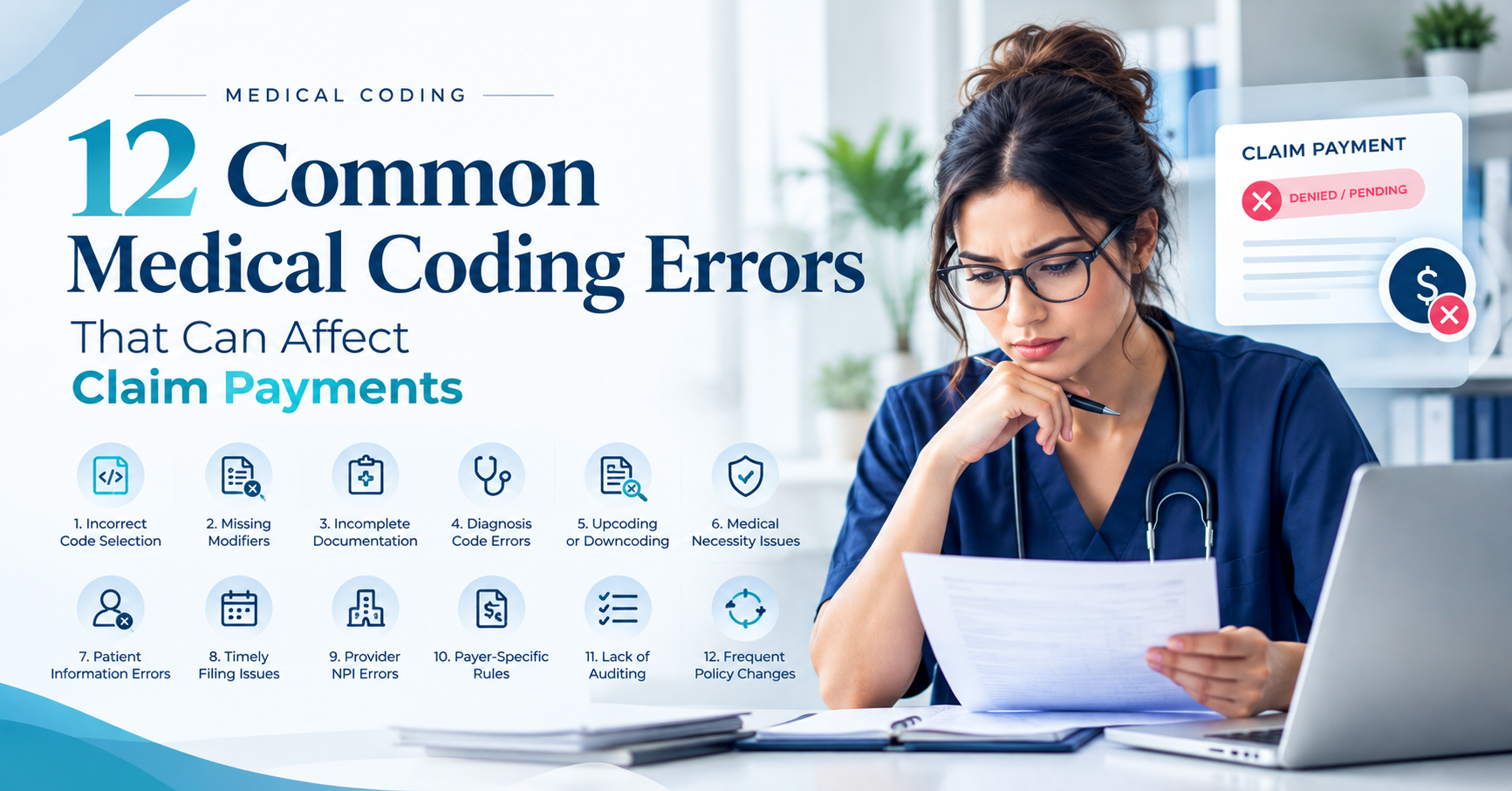
Many of these overlap with the broader list of 12 common medical coding errors that can affect claim payments, and behavioral health adds its own twists on top.
Why Mental Health Billing Is Harder Than It Looks
Behavioral health billing carries a mix of challenges you do not see in most other specialties:
Time-based codes where the note has to match the minute count
Frequent audits on high-value codes like 90837
Session limits, authorizations, and carve-out vendors that change by plan
Many provider types with different billing rules (LCSW, LPC, LMFT, psychologist, psychiatrist, NP)
Telehealth rules that differ for Medicare, Medicaid, and commercial plans
Secondary insurance and family coverage issues, which we cover in our guide on coordination of benefits for behavioral health practices
None of this has anything to do with how well you treat patients. It is all administrative. But it decides how fast you get paid, and how much of your income stays with you.
How Avorcms Services Supports Mental Health Practices
Avorcms Services provides behavioral health billing services built around how therapy and psychiatry practices actually run. We work as an extension of your front desk and back office, so your clinicians can stay focused on patients.
Here is what that looks like for a mental health practice:
Coding that matches your notes. Our certified coders review CPT, ICD-10, modifier, and time-based coding so claims go out supported by documentation.
Eligibility, benefits, and authorization checks. We confirm mental health benefits, session limits, carve-out vendors, and authorization needs before the visit, not after the denial.
Telehealth-ready billing. We keep up with modifier and place-of-service rules by payer, so telehealth claims are not held up by technical details.
Credentialing and enrollment. New clinician or new payer? Our medical credentialing services handle CAQH, payer enrollment, and re-credentialing, so you can bill sooner.
Denial follow-up. When a claim does get denied, our denial management services find the cause, correct it, and work the appeal.
Full revenue cycle support. From charge entry to payment posting to reporting, we run your billing under one revenue cycle management program, with a dedicated account manager who knows your practice.
Clear reporting. You see collections, denials, and trends in plain language, with no hidden fees and no long-term lock-in.
Psychiatric Billing Services
Psychiatric practices have their own layer of complexity. Prescribers often combine E/M visits with therapy add-on codes, bill evaluations with medical services, and offer services like TMS. Each of these brings its own documentation, modifier, and authorization rules.
Our psychiatric billing services pair coding review with payer-specific follow-up, so the E/M and psychotherapy components are billed together correctly and paid as they should be.
Mental Health Billing Services in Florida
Avorcms Services is based in St. Petersburg, Florida, and supports behavioral health providers across the state and the rest of the country. Florida practices often deal with a mix of commercial plans, Medicare, and Medicaid managed care plans, each with its own credentialing steps, authorization rules, and behavioral health carve-outs.
If you are looking for mental health billing services in Florida, our team can handle the payer mix you actually see, from solo therapists to multi-clinician group practices.
Signs Your Practice May Need Outside Billing Help
Your 90837 claims are being downcoded or audited
Denials for time, modifiers, or authorizations keep repeating
Claims are aging past 60 or 90 days
You have added clinicians or payers and billing is falling behind
Your staff spends more time on billing than on patients
You are not sure what your clean claim or denial rate is
If two or more of these sound familiar, a quick review will show where revenue is slipping away. Our free medical billing audit is a good first step.
Get Paid Correctly for the Care You Provide
Your work is clinical. Your billing should be handled by people who know the codes, the payers, and the rules that change every year. Avorcms Services helps behavioral health providers get paid faster, deny less, and focus more on patients.
👉 Request your free billing audit | [email protected]
Frequently Asked Questions
1. What are the most common mental health CPT codes?
The most commonly billed mental health CPT codes are 90791 for diagnostic evaluation, 90832, 90834, and 90837 for individual psychotherapy, 90847 for family therapy with the patient, and 90853 for group therapy. Crisis codes 90839 and 90840 are used less often but matter in urgent situations.
2. What is the difference between 90834 and 90837?
90834 is for a psychotherapy session of 38 to 52 minutes, and 90837 is for 53 minutes or longer. The code must match the actual time with the patient, and the note should support it.
3. What is the difference between 90791 and 90792?
Both are psychiatric diagnostic evaluations. 90791 does not include medical services, while 90792 does, so it is typically billed by prescribers such as psychiatrists and psychiatric nurse practitioners.
4. Can you bill 90837 and 90791 on the same day?
Many payers do not allow it, since the evaluation and therapy are treated as overlapping services. Rules vary by plan, so confirm with each payer before billing both.
5. What modifier do you use for telehealth mental health sessions?
Many payers use modifier 95 for real-time audio-video sessions and 93 for audio-only. Medicare has also used modifier FQ for some audio-only mental health services. Place of service codes such as 10 and 02 may also apply, depending on where the patient is.
6. What is the 90785 interactive complexity code?
90785 is an add-on code used with certain evaluations and psychotherapy services when specific communication barriers or third-party factors make the session more complex. It is not meant for sessions that are simply difficult or emotionally intense.
7. How is psychiatric medication management billed with therapy?
Prescribers typically bill an E/M code for medication management and add a psychotherapy add-on code (90833, 90836, or 90838) based on therapy time. The note must show that both services were done and are separate.
8. Why do mental health claims get denied?
Common reasons include time and code mismatches, missing authorizations, wrong telehealth modifiers, credentialing gaps, session limits, carve-out vendor issues, and coordination of benefits errors.
9. Do mental health billing services handle credentialing too?
Some do. At Avorcms Services, credentialing, payer enrollment, and CAQH maintenance are part of our support, so clinicians can start billing sooner and avoid enrollment-related denials.
10. Does Avorcms Services offer mental health billing services in Florida?
Yes. We are based in St. Petersburg, Florida, and work with behavioral health practices throughout Florida and across the United States. Call (727) 662-8558 or email [email protected], and we respond within 24 hours.
Disclaimer: This blog is for informational purposes only and is not legal, compliance, or billing advice. Codes and payer rules change, so confirm details with each payer.