
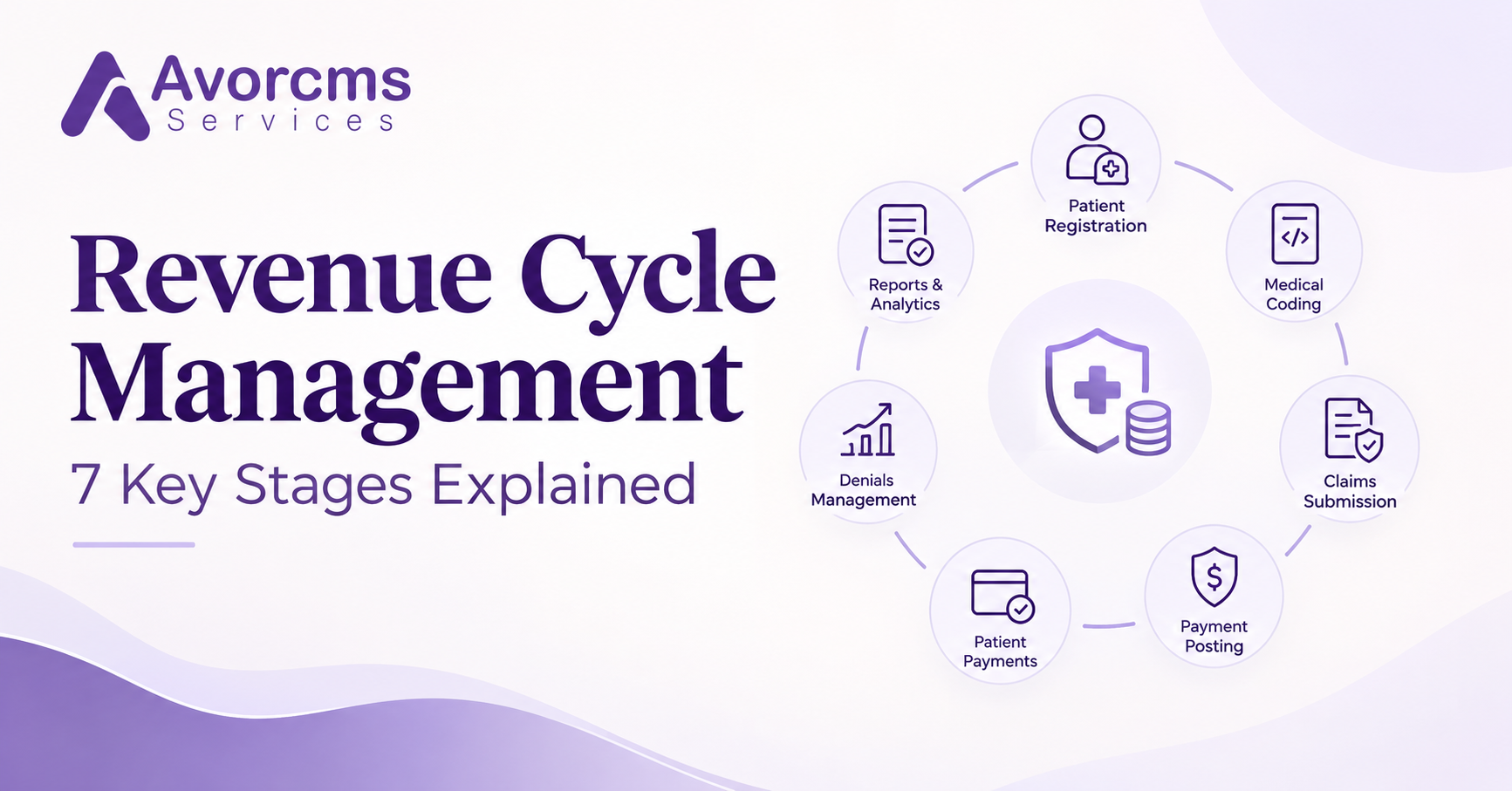
What is revenue cycle management? A guide to the 7 key stages of the healthcare revenue cycle, from registration and coding to denials and collections.
If your practice is delivering good care but still waiting on payments, watching denials pile up, or unsure where money is leaking, the problem is usually somewhere in your revenue cycle. Every patient visit sets off a chain of financial steps, and a breakdown at any one of them delays or loses the payment you already earned. Most practices feel the symptoms long before they can name the stage where things went wrong.
The good news is that the process follows a clear, repeatable path. Once you understand the seven key stages of revenue cycle management, from scheduling a patient to collecting the final balance, you can see exactly where claims stall, where revenue slips, and what to fix first. You can run this process with in-house staff or hand it to a billing partner who manages every stage for you.
At Avorcms Services, our revenue cycle management services cover the full cycle for healthcare providers, from eligibility and coding through claims, denials, and collections, so revenue does not slip through the cracks.
Revenue cycle management (RCM) is the financial process healthcare providers use to track a patient's care from scheduling through final payment. It covers seven key stages: patient scheduling and registration, eligibility verification, charge capture and coding, claim submission, payment posting, denial management and accounts receivable follow up, and patient collections and reporting. Managed well, it means faster payments, fewer denials, and a healthier bottom line.
The seven stages in order:
Patient scheduling and registration
Insurance eligibility verification and prior authorization
Charge capture and medical coding
Claim submission
Payment posting
Denial management and accounts receivable follow up
Patient collections and reporting
If any stage is costing your practice revenue, Avorcms Services can manage the full cycle for you.
Stage | What happens | Why it matters |
1. Scheduling and registration | Capture patient demographics and insurance details | Bad data here causes most downstream denials |
2. Eligibility and authorization | Confirm coverage, benefits, and prior authorizations | Prevents denials for coverage and authorization |
3. Charge capture and coding | Record services and assign correct codes | Wrong codes mean wrong or lost payment |
4. Claim submission | Scrub and send clean claims to payers | Clean claims get paid faster |
5. Payment posting | Post payer payments and adjustments | Reveals underpayments and patient balances |
6. Denials and AR follow up | Rework, appeal, and chase unpaid claims | Where most recoverable revenue is won or lost |
7. Collections and reporting | Bill patients and track performance | Protects cash flow and guides decisions |
What Is Revenue Cycle Management (RCM)?
Revenue cycle management, also called healthcare revenue cycle management, is the complete financial process a practice uses to capture, manage, and collect payment for the care it delivers. It runs from the moment a patient schedules an appointment to the moment the final balance is paid in full.
Medical billing and RCM are related but not the same. Billing is one part of the cycle, the submission of claims and posting of payments, while revenue cycle management covers the entire journey, including eligibility, coding, denials, patient collections, and reporting. Medical revenue cycle management is what turns care delivered into payment received, and a weak link anywhere along the way shows up as delayed cash and lost revenue.
Why Does Revenue Cycle Management Matter?
Revenue cycle management matters because it decides how much of the money you earn you actually collect, and how quickly. A strong cycle keeps cash flowing, while a weak one leaves earned revenue sitting in denials and aging accounts.
Cash flow. Faster, cleaner claims mean payments arrive in weeks, not months.
Fewer denials. Catching errors early keeps claims from bouncing back unpaid.
Compliance. Accurate coding and documentation reduce audit and payback risk.
Patient experience. Clear eligibility checks and statements prevent billing surprises.
Stage 1: Patient Scheduling and Registration
The revenue cycle begins before the patient walks in, when your team collects accurate demographic and insurance information. This stage, sometimes called preregistration, sets up everything that follows.
Getting names, dates of birth, insurance IDs, and coverage details right at this point prevents a large share of later denials. A single wrong digit in a member ID or an outdated plan can cause a claim to be rejected weeks later, long after the visit.
Stage 2: Insurance Eligibility Verification and Prior Authorization
Before the visit, confirm the patient's active coverage, benefits, and any prior authorization the service requires. Eligibility and authorization problems are among the most common reasons claims are denied.
Verification only helps if the provider is also in network with the payer, which is a provider credentialing matter, not just an eligibility one. Checking benefits up front also tells you the patient's expected responsibility, so collections later are faster and less of a surprise.
Stage 3: Charge Capture and Medical Coding
Charge capture records every service the provider performs, and medical coding translates those services into standardized CPT, ICD 10, and HCPCS codes for billing. Coding accuracy directly drives whether you are paid correctly.
Missed charges are revenue you never bill for, and incorrect codes cause denials or underpayment. Because coding sits at the center of the cycle, small mistakes here add up quickly, as our guide to medical coding errors explains.
Stage 4: Claim Submission
Coded charges become claims that are scrubbed for errors and submitted to payers, usually through a clearinghouse. A clean claim that passes payer edits on the first try is the fastest path to payment.
This is the stage most people picture when they think of medical billing, and it is where reliable medical billing services make the biggest visible difference. Claims that go out with missing or mismatched information get rejected and have to be reworked, which delays your cash.
Stage 5: Payment Posting
When payers respond, payments and adjustments are posted against each claim using the electronic remittance advice or explanation of benefits. Accurate posting is how you see what was actually paid versus what was billed.
Posting is not just data entry. It surfaces underpayments, contractual adjustments, and the balances that move to a secondary payer or to the patient. Sloppy posting hides revenue you are owed.
Stage 6: Denial Management and Accounts Receivable Follow Up
Denied and unpaid claims are identified, corrected, appealed, and resubmitted, while aging accounts receivable are followed up until they are resolved. This stage is where most recoverable revenue is either collected or quietly written off.
Our denial management process finds the root cause of each denial and reworks the claim.
Older balances are chased by our AR recovery specialists, who work claims many billing teams abandon.
The common reasons medical claims are denied guide covers what to check first.
Stage 7: Patient Collections and Reporting
After the payers have paid, the patient is billed for their remaining responsibility, and reporting tracks how the whole cycle is performing. With high deductible plans common, the patient portion is now a large share of practice revenue.
Clear, timely statements and easy payment options improve how much you collect from patients. Reporting closes the loop, showing you where claims stall and where revenue leaks so you can fix the process, not just the symptom.
How Do You Measure Revenue Cycle Performance?
You measure revenue cycle performance with a handful of key metrics that show how clean, fast, and complete your collections are. Tracking them tells you which stage needs attention.
Metric | What it measures | Commonly cited target |
Clean claim rate | Share of claims accepted on first submission | 95% or higher |
First pass resolution rate | Claims paid on the first try without rework | 90% or higher |
Days in accounts receivable | Average time to collect payment | Under 40 days |
Denial rate | Share of claims denied by payers | Under 5 to 10% |
Net collection rate | Share of collectible revenue actually collected | 95% or higher |
These targets are commonly cited benchmarks and vary by specialty and payer mix, so use them as a direction to aim for rather than a hard rule.
What Are Common Revenue Cycle Management Challenges?
Most revenue cycle problems come from a few weak stages rather than the whole process being broken. Finding the weak link is usually the fastest way to recover revenue.
Registration and eligibility errors. Bad patient or coverage data that surfaces as denials later.
Coding mistakes. Missed charges or incorrect codes that reduce payment.
Slow claim submission. Claims that sit before they are sent, delaying cash.
Unworked denials. Denied claims no one has time to appeal.
Aging accounts receivable. Old balances that slip past timely filing.
Weak patient collections. Unclear statements and no easy way to pay.
If you are not sure where the leaks are, a medical billing audit reviews your recent claims, denials, and coding to show exactly where revenue is being lost.
Should You Outsource Revenue Cycle Management?
In house RCM works when you have trained staff with time to manage every stage, from eligibility to appeals to patient collections. It becomes difficult when your team is stretched, denials are climbing, or you are growing faster than you can hire.
Outsourcing to RCM services gives you a team that works every stage and the reporting to prove it. Healthcare RCM services make the most sense when accuracy and consistent follow up matter more than keeping everything in house, since the stages that in-house teams let slide, denials and aging AR, are exactly the ones a dedicated partner is built to work.
How Can Avorcms Services Help With Revenue Cycle Management?
Avorcms Services provides revenue cycle management solutions for healthcare providers, covering every stage from patient eligibility and coding through claims, payment posting, denials, and collections. We work as an extension of your team, with a dedicated account manager who knows your practice.
Our healthcare RCM services connect directly to the rest of your billing operation. That includes reliable claim submission, denial management, and AR recovery, all reported back to you in one place. We deliver RCM for healthcare providers across the specialties we serve, including behavioral health, therapy and rehabilitation, family and internal medicine, OB GYN, chiropractic, pediatrics, ophthalmology, and orthopedics.
Run a Cleaner, Faster Revenue Cycle
Every claim stuck in your revenue cycle is money your practice has already earned. A clear process, clean claims, and steady follow up at every stage make the difference between revenue collected and revenue lost. Let our team find the weak stages and work them for you.
👉 Request your free billing audit | [email protected] | Reach the Avorcms Services team
Serving independent practices, group practices, and healthcare providers across the United States.
Frequently Asked Questions
1. What is revenue cycle management in healthcare? Revenue cycle management is the financial process that tracks a patient's care from scheduling through final payment. It covers eligibility, coding, claims, payment posting, denials, and collections.
2. What are the stages of the revenue cycle? The seven key stages are patient scheduling and registration, eligibility verification and prior authorization, charge capture and coding, claim submission, payment posting, denial management and AR follow up, and patient collections and reporting.
3. What is the difference between medical billing and revenue cycle management? Medical billing is one part of the cycle, focused on submitting claims and posting payments. Revenue cycle management covers the entire process, including eligibility, coding, denials, patient collections, and reporting.
4. Why is revenue cycle management important? It decides how much of the revenue you earn you actually collect and how fast. A strong cycle protects cash flow, reduces denials, and keeps the practice compliant.
5. What metrics measure revenue cycle performance? Common metrics include clean claim rate, first pass resolution rate, days in accounts receivable, denial rate, and net collection rate. They show which stage of the cycle needs attention.
6. What causes revenue leakage in the revenue cycle? Leakage usually comes from registration and eligibility errors, coding mistakes, unworked denials, aging accounts receivable, and weak patient collections. A billing audit can pinpoint where it is happening.
7. What is denial management in RCM? Denial management is the process of finding why claims were denied, correcting the cause, and appealing or resubmitting them. It is one of the biggest sources of recoverable revenue in the cycle.
8. Should a practice outsource revenue cycle management? Outsourcing makes sense when denials are rising, accounts receivable are aging, or the team cannot keep up with every stage. A partner works the full cycle and reports on performance.
9. How does RCM improve cash flow? By submitting cleaner claims, catching denials early, and following up on unpaid balances, RCM shortens the time from visit to payment and reduces the revenue that is never collected.
10. How can Avorcms Services help with revenue cycle management? Avorcms Services manages the full revenue cycle, including billing, denials, AR recovery, and reporting. You can contact our RCM team, call (727) 662 8558, or email [email protected], and we respond within 24 hours.
Disclaimer: This blog is for informational and educational purposes only and does not constitute legal, compliance, or financial advice. Payer requirements and performance benchmarks vary, so confirm details with each payer.