Compare medical billing outsourcing vs in-house billing: real staffing costs, outsourcing fees, revenue impact and the signs it is time to outsource medical billing.
Most practices compare billing options the wrong way. They put a biller's salary next to an outsourcing fee and pick the smaller number. That comparison misses most of the real cost on both sides, and almost all of the revenue difference.
The true question is not "what does billing cost?" It is "how much of what we earn do we actually collect, and what does it cost us to collect it?" A cheaper billing setup that collects 6% less is not cheaper at all.
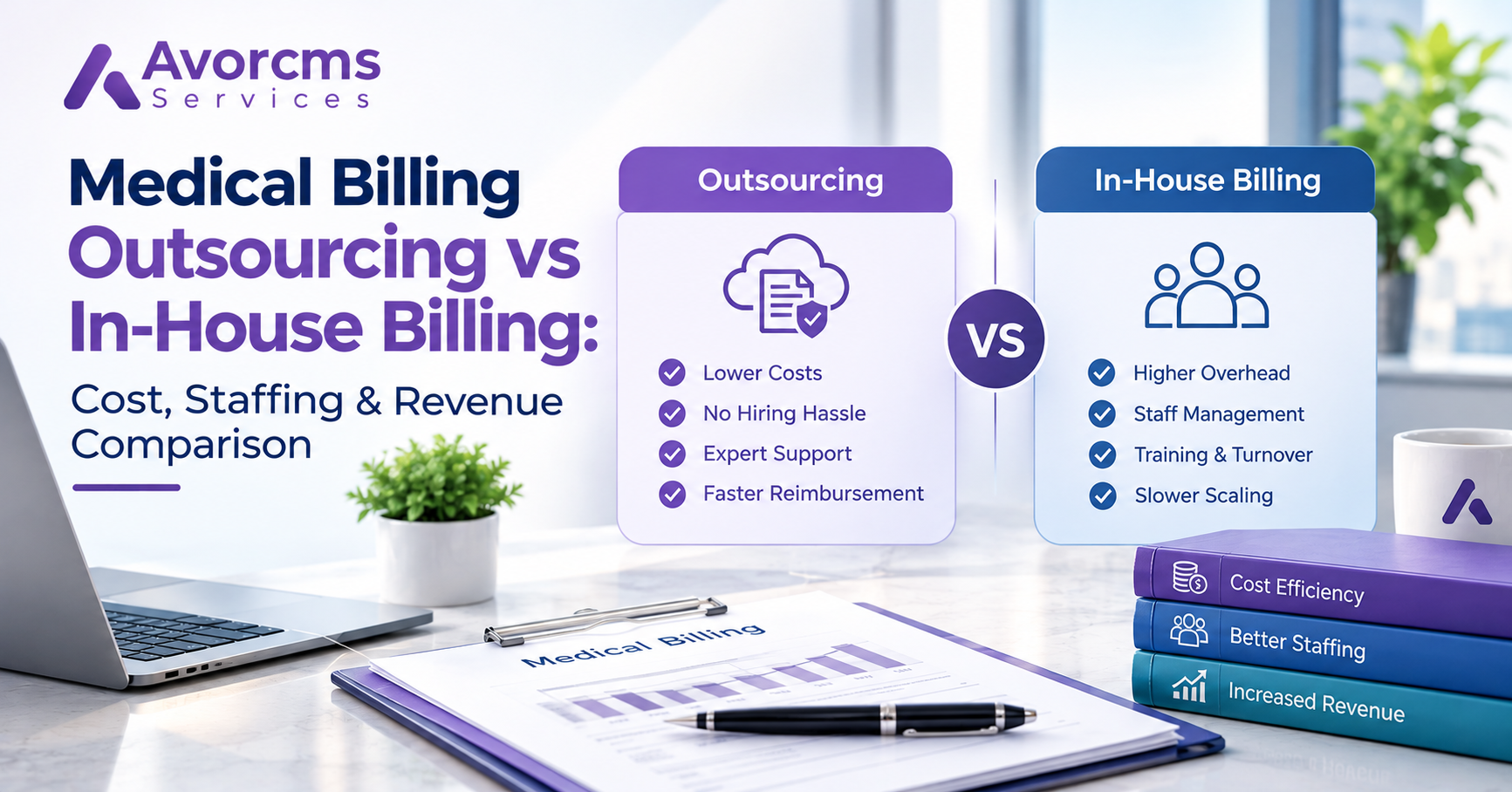
This guide compares medical billing outsourcing vs in-house billing across the three things that matter: total cost, staffing risk, and revenue. It includes a worked cost example, the pricing models billing companies use, the signs it is time to outsource medical billing, and what to look for in a medical billing company.
Is outsourcing medical billing cheaper than in-house billing?
For most small and mid-sized practices, yes. An in-house biller earns a median of about $51,000 a year, and benefits add roughly 30% more, before software, training and coverage for time off. Outsourced medical billing services usually cost 4% to 10% of collections, most often 5% to 7%. The bigger difference is revenue: a specialized billing team with denial follow-up and AR recovery often collects more of what the practice earns, which can outweigh the fee.
What Medical Billing Really Involves
Billing is not one job. It is a chain of tasks that must all happen on time: eligibility checks, charge entry, coding review, claim scrubbing, submission, rejection fixes, payment posting, denial appeals, AR follow-up, patient statements, and reporting. Our guide on how medical billing works walks through each step.
When you compare in-house and outsourced billing, you are really asking who does all of these tasks, how well, and at what total cost. A setup that handles submission well but lets denials and old AR slide will look cheap and still lose money.
The True Cost of In-House Billing
The salary is only the start. These are the costs most practices forget to count:
Salary. The median pay for medical records specialists, the group that includes billers and coders, was $51,140 a year in May 2025.
Benefits and payroll taxes. Across private employers, benefits make up about 30% of total pay costs. That turns a $51,000 salary into about $73,000 in real cost.
Software and clearinghouse fees. Billing modules, claim scrubbers and clearinghouse charges are often billed per provider or per claim.
Training and certification. Coding and payer rules change every year. Staff need ongoing education to keep up.
Coverage. When a biller is sick, on vacation or leaves, claims stop. Hiring and training a replacement can take months.
Management time. A practice manager or physician spends time supervising billing instead of running the practice.
The hidden cost is the work that does not get done. One biller who also checks eligibility and answers phones rarely has time to work every denial or call on every claim past 60 days.
What Medical Billing Outsourcing Costs
Medical billing outsourcing services are usually priced in one of three ways:
Pricing model | How it works | Typical range |
Percentage of collections | The company earns a share of what it collects | 4% to 10%, most often 5% to 7% |
Flat fee | A set monthly price per provider, or a fee per claim | About $100 to $500 per provider per month, or a few dollars per claim |
Hybrid | A small monthly base plus a lower percentage | Varies by practice size and specialty |
The percentage model is the most common, because it ties the company's income to your collections. If they collect more, you both earn more. Smaller practices usually see rates at the higher end of the range, and larger groups at the lower end.
The real medical billing outsourcing cost depends on what is included. Ask whether the fee covers eligibility checks, coding review, denial management, AR follow-up on old claims, credentialing and reporting, or whether those are billed on top.
A Worked Cost Comparison
Here is an illustration for a practice that collects $1,000,000 a year. The in-house numbers use national averages and a modest software estimate. Your numbers will differ.
Cost item | In-house (1 biller) | Outsourced at 6% |
Biller salary | $51,000 | $0 |
Benefits and payroll taxes (about 30% of total cost) | $22,000 | $0 |
Software and clearinghouse (estimate) | $6,000 to $12,000 | Usually included |
Training and certification | $1,000 to $2,000 | Included |
Outsourcing fee | $0 | $60,000 |
Estimated yearly cost | $80,000 to $87,000 | $60,000 |
This comparison still leaves out the cost of turnover, coverage for time off, and management time. It also assumes one biller can handle all the work. Many practices of this size need more than one person to keep up with denials and AR.
The Revenue Side Matters More
Cost is only half the story. The bigger number is how much of your earned revenue is actually collected.
Say a stronger billing process lifts collections by just 4%, through cleaner claims, faster denial appeals and steady follow-up on old AR. For a practice collecting $1,000,000, that is $40,000 more a year. The outsourcing fee on that extra revenue is about $2,400. The rest goes to the practice.
This is where specialist billing teams earn their fee. They work every denial, follow up on every unpaid claim, and track payer rules across many practices. Fixing the front end matters too: our guide to improving your clean claim rate shows why claims that are right the first time get paid much faster.
Side-by-Side: In-House vs Outsourced Medical Billing
Factor | In-house billing | Outsourced medical billing |
Cost | Salary, benefits, software, training, overhead | A set fee or a percentage of collections |
Staffing risk | Billing stops when staff are out or leave | A team covers the work without gaps |
Expertise | Depends on one or two people | Specialists in coding, denials, AR and credentialing |
Keeping up with rule changes | Practice must train staff | Company tracks payer and CMS updates |
Denials and old AR | Often left behind when the team is busy | Worked on a set schedule |
Control and visibility | Direct, in the same office | Reports, dashboards and an account manager |
Scaling | Hire and train for each new provider | The team grows with the practice |
When In-House Billing Makes Sense
In-house billing can be the right fit when the practice has an experienced billing team with low turnover, strong results (days in AR near 30 to 40, denials under 5%), and the volume to keep a full team busy. Large groups with their own billing department and leadership often fall into this group.
Signs It Is Time to Outsource Medical Billing
Days in AR are above 45, or more than 15% of AR is over 90 days
Denials are rising and many are never appealed
Your biller is also doing front desk, scheduling or other jobs
Billing stops when one person is out
A new provider, location or specialty is being added
Your providers or manager spend evenings answering billing questions
You do not have clear monthly reports on collections and denials
If several of these sound familiar, you are likely already paying the cost of in-house billing in lost revenue.
What to Look For in a Medical Billing Company
Not every medical billing company works the same way. Before you sign, ask:
What is included in the fee? Denial management, AR follow-up, credentialing and patient statements should be clear.
Do they know your specialty? Therapy, behavioral health and primary care each have their own billing rules.
Who will work your account? A dedicated account manager matters more than a large team you never speak to.
What do they report, and how often? You should see collections, denials, AR aging and days in AR every month.
Are they HIPAA compliant? Ask how they protect patient data and who has access.
What does the contract require? Avoid long lock-ins and hidden fees.
Will they review your current billing first? A good partner shows you where revenue is being lost before you commit.
How Avorcms Services Helps
Avorcms Services provides outsourced medical billing services for independent and group practices that want more of their earned revenue collected, without adding staff. We act as an extension of your team, not a black box.
Here is what you get:
End-to-end billing, from eligibility checks and charge entry to claim submission within 24 to 48 hours.
Certified coders who review claims before they go out.
Denial management that finds the root cause and appeals fast.
AR follow-up on every unpaid claim, including old balances many billing companies leave behind.
Full revenue cycle management, including credentialing and prior authorization support.
A dedicated account manager and clear monthly reports, with no long-term lock-in and no hidden fees.
We provide medical billing services for healthcare providers in behavioral health, therapy and rehabilitation, family and internal medicine, and many other specialties. As a medical billing company in St. Petersburg, FL, we support practices across Florida and the United States.
See What Your Billing Is Really Costing You
The best way to compare is with your own numbers. Our team will review your current billing, show your real cost to collect, and find where revenue is slipping through denials, old AR or claim errors.
Start with a free medical billing audit, call (727) 662 8558, or email [email protected]. We respond within 24 hours.
Frequently Asked Questions
1. How much does medical billing outsourcing cost?
Most companies charge 4% to 10% of collections, and 5% to 7% is the most common range. Some charge a flat monthly fee per provider or a fee per claim instead.
2. Is it cheaper to outsource medical billing or keep it in house?
For most small and mid-sized practices, outsourcing costs less once you add salary, benefits, software, training and coverage for time off. It also tends to collect more of what the practice earns.
3. How much does an in-house medical biller cost?
The median pay for medical records specialists, including billers, was $51,140 a year in May 2025. Benefits add about 30% to total cost, before software and training.
4. What does a medical billing company do?
A medical billing company handles the tasks that turn visits into payments: eligibility checks, coding review, claim submission, payment posting, denial appeals, AR follow-up and reporting.
5. Will I lose control of my billing if I outsource?
No, if you pick the right partner. You should get monthly reports, access to claim status, and a dedicated account manager who answers your questions.
6. Is outsourced medical billing HIPAA compliant?
It should be. A reputable company signs a business associate agreement and follows HIPAA rules for data access, storage and transfer. Always ask before signing.
7. How long does it take to switch to an outsourced billing company?
Onboarding often takes a few days to a few weeks, depending on your software and payer setup. A good partner works old AR from your previous system during the move.
8. When should a practice outsource medical billing?
Consider it when denials are rising, days in AR stay above 45, billing stops when one person is out, or you are adding providers or locations.
9. What should be included in an outsourcing fee?
At a minimum: claim submission, payment posting, denial management, AR follow-up and reporting. Ask whether credentialing, eligibility checks and patient statements are included or extra.
10. Is Avorcms Services a medical billing company in St. Petersburg, FL?
Yes. Avorcms Services is based in St. Petersburg and provides outsourced medical billing for practices across Florida and the United States. Call (727) 662 8558 or email [email protected].
Disclaimer: This blog is for informational and educational purposes only and does not constitute legal, compliance, or financial advice. Cost figures are national averages and estimates. Your practice's costs will vary.